Saturday, January 25, 2014

"Worlds Without Number" - Exoplanets and LDS Beliefs

In Moses, we read that God has created "worlds without number" (Moses 1:30) and it is strongly implied that many of these worlds have inhabitants on them that are similar to us.

In my last entry I wrote about finding and characterizing Earth-like planets, and I just glossed over the fact that we actually have discovered thousands of potential planets around other stars, known as extrasolar planets or exoplanets. This is one example where science has corroborated revelations given nearly two centuries ago, in that we think the number of worlds or planets in our galaxy like numbers in the 100's of billions - certainly enough to qualify as "worlds without number."

Diagram for the radial velocity method to detect exoplanets.
First, a little bit of background on exoplanets and how they're discovered. The first exoplanet around a star like the Sun was discovered in 1995. The way it was discovered was by looking at the slight change in the star's position from the planet. You see, we think of planet's orbiting around stars and the stars staying put, but in reality the star "orbits" around the planet too - it just moves far less than the planet does. So as the planet moves around the star, the star moves in response. When the star's position changes, it's velocity or speed towards us will change, and then we can take advantage of a physical effect known as the Doppler Effect. Everyone knows what this is even if they don't know the term - you know when a fire truck or ambulance is coming towards you and you can hear the pitch of the siren change as it passes you? That's the Doppler Effect, only instead of talking about the pitch (or frequency of the sound) change, we're talking about the frequency (or color) of light changing. So as the star moves in it's "orbit," we see it's color change a very minuscule amount, and from that we can infer that there must be a planet orbiting the star.

How transit work - we see a dip in the star's
brightness and infer a planet must be there.
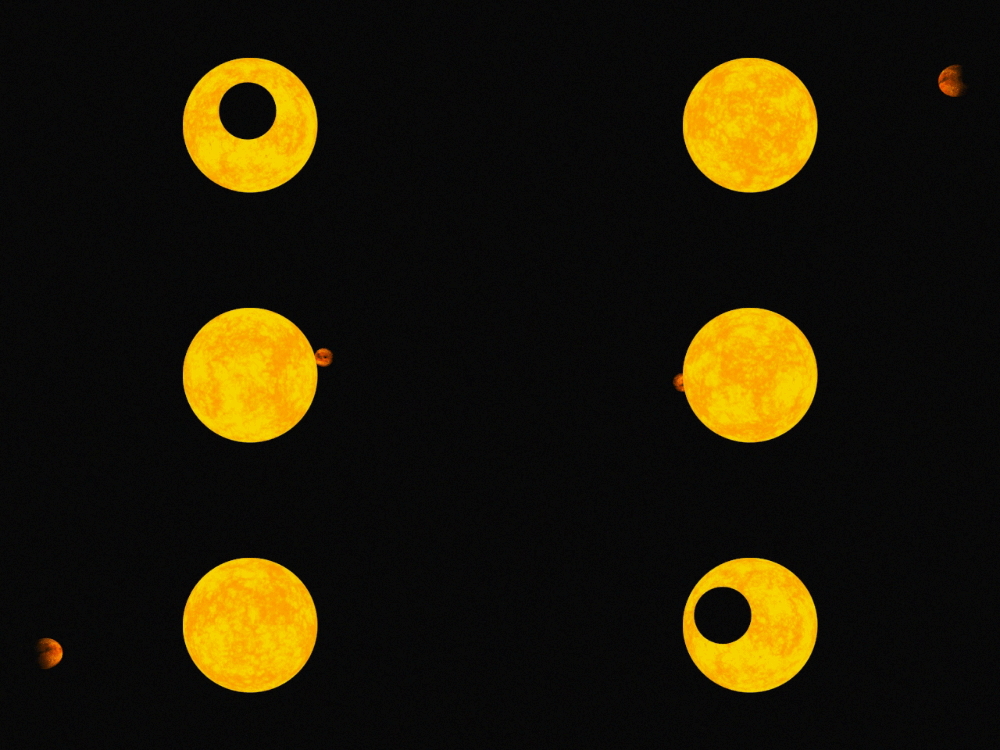
The other main method of detecting a planet is called the transit method. This is one is thankfully much more intuitive. For certain planet-star systems, the orientation is just right that we can actually see the planet pass in front of the star, like in an eclipse. Planets are much, much fainter than stars so when the planet is in front of the star, we see a decrease in the amount of light from the planet, and based on the amount that the light decreases by we can not only tell that there's a planet, but also how big the planet is relative to the star. You might have read news articles about planets being discovered by a mission called Kepler. The Kepler spacecraft stared at one spot in the sky for more than 3 years looking for transiting planets, and it found thousands of them. It's made the transit method the most successful method for finding planets to date.

So now that the background is out of the way, what do the results mean? Well, first off, we've found a lot of planets. You can check this site to get an up to date count, but as of right now we're at over 1,000 confirmed planets and over 3,600 planet candidates (likely to be planets, but need follow-up observation). Based on the statistics from missions like Kepler, there should be billions of planets in our galaxy alone, and in the universe, probably trillions.

But I think the most interesting part about all these discoveries is that God thew a bunch of things at us that we never expected. A lot of people more or less assumed that exoplanet solar systems would be a lot like our own solar system - rocky planets in the inner part, gas giant planets in the outer part, all with nice and neat circular orbits. But that's not what we've seen at all. We've found that about 1% of stars have what are called Hot Jupiter planets, planets that are the size of Jupiter but found 10 times closer to their star than Mercury is to our Sun. There have been planets found with highly elliptical (non-circular) orbits, and also planets in multi-planet systems where the inclinations are completely misaligned - meaning that instead of the orbits lying on a flat surface, they criss-cross each other. There are a lot of planets that have sizes between Earth-sized and Neptune-sized, things that we really don't know anything about because we don't have anything like that in the solar system. It really seems like God has created every single planet he possibly could in this wondrous universe.

It's tempting for me to think that our solar system is unique and that it's not possible to have life on a planet without having the exact right setup, but I'm sure I would be proven wrong eventually. The neat thing about these planets is that they're all, in some way or another, created to bring to pass the work of Heavenly Father - the immortality and eternal life of His children, which includes us! Even in our own solar system we have 7 other planets, countless moons and dwarf planets and a large number of asteroids and other small objects, and it's all for us. How amazing is that? And more so, how humbling is that?

So in conclusion, in exoplanets, as well as in our own lives, God helps us to remember that He knows far more than we do. He is constantly surprising us and throwing new concepts and challenges at us. There are indeed "worlds without numbers" out there, in all shapes and sizes and there will be things we never expected to see, but God knows all His creations, and He has created them for own purpose - to save His children.

Tuesday, January 21, 2014

The Quest to find an Earth-like Planet


This is a tremendously exciting time to be an astronomer, or just anyone with an interest in science. Why? Because of fast-paced field of exoplanets, or planets around other stars. There's way too much about this field to cover in one post, but to keep it short, the progress that's been made in a relatively short amount of time is amazing. Less than 20 years ago, the first exoplanet was discovered. A couple decades and thousands of planets later, we're not just discovering exoplanets, we're also starting to be able to characterize them and learn about their atmospheres.

I was at the American Astronomical Society (AAS) meeting in Washington D.C. a couple weeks ago. This is the biggest astronomy meeting in the world, with about 3000 people registered for the conference. At the meeting, there were several talks about an observational technique called transit transmission spectroscopy, which incidentally happens to be what my dissertation is on. For some exoplanets, the exo-solar system is aligned just right that our viewing angle lets us see the planet pass in front of the star, or transit. This is one of the main ways we discover exoplanets - by looking for the dip in the star's light as the planet transits it. But what's more interesting to me is that some of the star's light passes through the planet's atmosphere, where it can be absorbed and scattered by molecules and particles in the atmosphere. The atmosphere leaves a spectral signature on the light, which can then be used to figure out what the atmosphere is made up of and potentially even the pressure and temperature that we can see.

Animation of a transiting planet. We see a dip in the star's light when the planet passes in front of the star


You can imagine that you need pretty good precision to be able to do this. Star's are incredibly bright, and planets are, well, not very bright at all. The percentage dip in stellar light from a transiting planet is maybe 1% for a lot of the planets being characterized (for a true Earth-like planet, it'll be closer to 0.01%). But that's for the planet as a whole. For just the atmosphere, the signal can be a lot lower. The current best precision is 30 parts per million. To give you a sense of how small that is, look at a light bulb in the room you're in. Now put a speck of dust on the light bulb. No, not a dust mite, literally a speck of dust. The decrease in the light bulb's brightness is about 30 parts per million. That's the level of precision we're getting for stars that are light years away.

But 30 parts per million isn't good enough. What we really want is to able to characterize the atmosphere of something like the Earth. And to do that even to the most minimal level we need to be precise enough to get 10 parts per million, and to be able to detect things like oxygen (which is a biosignature for photosynthesis and a very strong indicator of life) you'd probably need at least 1 part per million precision. Again, 1 part per million for a star that's light years away. Thankfully, we might actually be able to do this within the near future. The interesting thing about getting very precise measurements is that for these types of observations, the longer you look at something and the bigger the telescope you have, the better your precision. The current observations are using the Hubble Space Telescope for near 60 hours on one star. Within about 10 years, the James Webb Space Telescope, which has a collecting area about 7 times larger than Hubble.

So with the James Webb, it should be possible to actually get a good look at an Earth-like atmosphere within the next 10-15 years. I'm not saying it'll be easy, but it's at least possible. If there is another Earth out there that's relatively close by, we'll be able to find it and learn about it's atmosphere.


Thursday, January 16, 2014

Did Life Originate from a Global Chemical Reactor?

The origin of life remains one of the most open scientific questions in Astrobiology. While there's been great headway in both laboratory and theoretical understanding in how life may have originated, we still don't know when, where or how life originated.

Today's post revolves around this paper by Eva Stueken and others (mostly from the Univ. of Washington) I just reviewed in a seminar on a theory for the origin of life that looks at the early Earth as a global chemical reactor that could have led to the right reactants coming together to make life. The paper is open access, meaning anyone can go ahead and download it. The punchline of the paper is that instead of being a random event that occurred on the early Earth in one habitat, the origin of life was a more gradual process relying on multiple reactions from all over the Earth.

Most theories for the origin of life assume that life originated in one fairly limited region of the early Earth. This new theory looks at the exact opposite idea - what if life couldn't have formed in an isolated habitat? What if it required chemical reactions and transport schemes occurring all over the planet, perhaps not even at the same time?

The authors look at 8 different locales on the early Earth - the atmosphere, lakes and rivers, beaches, sea-ice, sea-surface micro layer, marine sediments, hydrothermal vents, and the oceanic crust. Each local has certain chemical reactions that are favored. For example, only places on or very near the surface have access to sunlight, which is important for a lot of the reactions believed to be necessary for life to form. On the other hand, hydrothermal vents are major sources of metals into the ocean, and therefore could play an essential role in the origin of life. Some people have even gone as far as to say that hydrothermal vents alone are where life originated.

Once the reactions occurred in each environment, there need to be various transport mechanisms to get the reaction products from one area to another. Thankfully, between winds, currents, tectonic outgassing and even convection in the crust, there's no reason to believe that this wasn't the case. So you could have molecule A form in a lake on the surface, molecule B form near a hydrothermal vent, molecule C from the sea-surface micro layer, and they all get together on the beach and suddenly...A+B+C = life.

Scientifically and theologically, the implications of this are profound. This is a hard theory to test, but if it were true, that would change the origin of life from a somewhat random event that relied on a specific chemical reaction occurring in one location to a more gradual, deterministic event that doesn't seem so improbable, if you have the right conditions.

What are the right conditions? It seems to be that you need a wide variety of environments. So perhaps if you have a planet like the Earth in the habitable zone of another star, life would have a high probability of forming.  But what about a world like Europa, where the ocean is (mostly) cut off from the surface? Well, if there might be mechanisms to transport products from the surface to the ocean, but it doesn't seem as likely as life originating on an Earth-like planet.

What does this mean theologically? That's a bit more speculative, but we know that we are created in God's image, so it would make sense if God put a system in place to have life originate in places like the Earth. It's not scientifically obvious that evolution would automatically lead to homo sapiens (most scientists would argue it wouldn't) but there's still so much we don't understand about this topic.

Tuesday, January 14, 2014

The Creation - A scriptural interpretation

I've always been fascinated by the Creation story described in Genesis 1-2 (and Moses 2-3 and Abraham 4-5). And quite frankly, I've always been a little uncomfortable with the notion that this has to describe the physical creation of the world. It really just doesn't match what we think happened over the course of the Earth's history, and that's been a major problem between science and religion. I've thought about ways to reconcile the 6 days of creation with current formation theories of the solar system and theories about how the Earth has evolved over time, but in all honesty, I just can't help shake the notion that Genesis 1-2 don't describe what physically happened.

But this doesn't have to be a roadblock for either scientists or religious people! There's lots of ways to reconcile scientific knowledge with the creation account, but let me just suggest one theory that was on my mind today. Just to summarize, the creation story is found in Genesis 1-2. The first part (up until Genesis 2:4) describes the six days of creation, including making man, and the seventh day of rest. Genesis 2 talks about the creation of Adam, the Garden of Eden, and the creation of Eve.

While I was reading the creation accounts today, the idea of the spiritual creation stood out to me. Genesis 2:5 reads:

 And every plant of the field before it was in the earth, and every herb of the field before it grew: for the Lord God had not caused it to rain upon the earth, and there was not a man to till the ground.

Or, a little more clearly in Moses 3:5 from the Pearl of Great Price:

 And every plant of the field before it was in the earth, and every herb of the field before it grew. For I, the Lord God, acreated all things, of which I have spoken, bspiritually, before they werecnaturally upon the face of the earth. For I, the Lord God, had not caused it to rain upon the face of the earth. And I, the Lord God, had dcreated all the children of men; and not yet a man to till theeground; for in fheaven gcreated I them; and there was not yet flesh upon the earth, neither in the water, neither in the air;
The basic idea is that all things were created spiritually before they were created physically. So when was the physical creation and when was the spiritual creation? I propose that Genesis 1 and the first part of Genesis 2 (the 6 days of creation) could be the spiritual creation. Here's 3 reasons why:

1) The six days of creation come before the part about Adam and Eve in the Garden of Eden, and the spiritual creation happened first
2) Wording of God - this has been noticed by many, many other people, but the six days of creation are done by "God" and the creation of Adam and everything after is done by the "Lord God," implying a difference between the two sets of creation
3) At least in LDS theology, Jesus Christ was the physical creator of the Earth, while God (Heavenly Father) directed it.

Regarding #2, "God" is usually meant to be Heavenly Father, the one true God, and "Lord God" is usually meant to be Jehovah, or Jesus Christ. Combined with point #3, this implies that Heavenly Father directly created all things spiritually, and Jesus Christ led the physical creation. This makes sense, because (in LDS theology at least) Jesus Christ was a spirit child of Heavenly Father, just like all of us. The one thing that doesn't match this is that the wording in Abraham 4-5 doesn't distinguish between "God" and "Lord God" at all. Everything is written as "the gods" did this or "the gods" did that.

The one major roadblock to this being true is this quote by Joseph Fielding Smith:

“There is no account of the creation of man or other forms of life when they were created as spirits. There is just the simple statement that they were so created before the physical creation. The statements in Moses 3:5and Genesis 2:5 are interpolations [parenthetical explanations] thrown into the account of the physical creation, explaining that all things were first created in the spirit existence in heaven before they were placed upon this earth.
“We were all created untold ages before we were placed on this earth. We discover from Abraham 3:22–28, that it was before the earth was formed that the plan of salvation was presented to the spirits, or ‘intelligences.’ This being true, then man, animals and plants were not created in the spirit at the time of the creation of the earth, but long before” (Doctrines of Salvation, 1:75–76).
It's also worth pointing out that the creation account in Abraham is after an account of all of us agreeing to the plan of salvation, which would presumably be after the spiritual creation in Joseph Fielding Smith's view. But, Doctrines of Salvation is not necessarily hard and fast doctrine. Joseph Fielding Smith (who was an avid opponent of evolution) could have mixed in his own opinions in this, without even intending too. And as I joked to my wife earlier today, I don't think Doctrines ever went through peer review...

Nevertheless, there are still a lot of open questions. If all things were created physically prior to Genesis 2, then why did Adam have to be created from the dust of the Earth? Why were all animals created after they should have already been there? Shouldn't Eve have already existed in some physical form before Adam's rib (or 'side, half', if you want a better translation) was removed to make her?

This is something I keep coming back to every few months. It's almost impossible for me not too. I can only hope that one day I'll get to learn about exactly what happened and what everything in these scriptures means. Unfortunately, I'm not sure I'll get any concrete answers in this life, but it's still fun and useful for me to think about.

Why This Exists

Hi Everyone! Seeing how I have exactly 0 followers right now this is more for people visiting in the future.

You might be wondering why I started this blog. There's a couple reasons, one being that it's something I should be doing, another that it could potentially look good on a resume. Assuming anybody ever reads this. But the main reason is that whenever I've done a google search for "LDS astrobiology" or some variant of that, all the results are garbage. Exmormon forum posts, random yahoo answers posts aren't about astrobiology at all. You can even try searching "Christian astrobiology" and "Muslim astrobiology" or whatever else you want, there's really not too much out there. (apologies to the few real links that have good stuff in them)

So I made this blog. As a member of the LDS church and a graduate student getting my PhD in Astronomy and Astrobiology, I feel like I have some authority to talk about these two subjects together. I hope to talk about issues in science and faith, new research discoveries in astronomy and astrobiology, and add in my own two cents every once in a while too.