This is a tremendously exciting time to be an astronomer, or just anyone with an interest in science. Why? Because of fast-paced field of exoplanets, or planets around other stars. There's way too much about this field to cover in one post, but to keep it short, the progress that's been made in a relatively short amount of time is amazing. Less than 20 years ago, the first exoplanet was discovered. A couple decades and thousands of planets later, we're not just discovering exoplanets, we're also starting to be able to characterize them and learn about their atmospheres.
I was at the American Astronomical Society (AAS) meeting in Washington D.C. a couple weeks ago. This is the biggest astronomy meeting in the world, with about 3000 people registered for the conference. At the meeting, there were several talks about an observational technique called transit transmission spectroscopy, which incidentally happens to be what my dissertation is on. For some exoplanets, the exo-solar system is aligned just right that our viewing angle lets us see the planet pass in front of the star, or transit. This is one of the main ways we discover exoplanets - by looking for the dip in the star's light as the planet transits it. But what's more interesting to me is that some of the star's light passes through the planet's atmosphere, where it can be absorbed and scattered by molecules and particles in the atmosphere. The atmosphere leaves a spectral signature on the light, which can then be used to figure out what the atmosphere is made up of and potentially even the pressure and temperature that we can see.
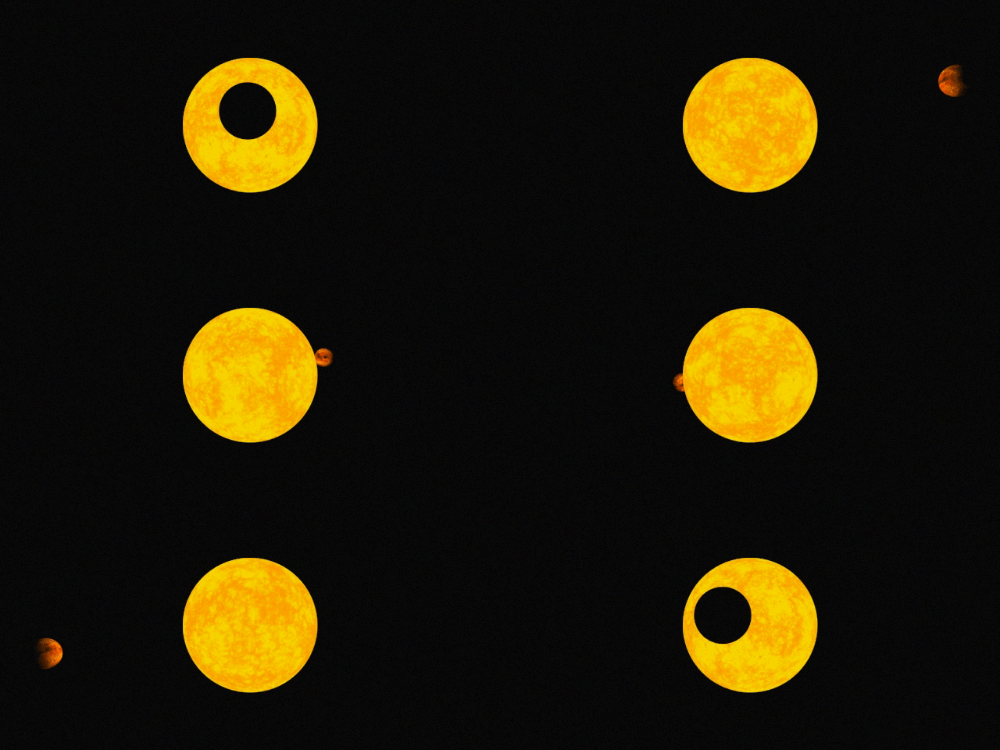 |
| Animation of a transiting planet. We see a dip in the star's light when the planet passes in front of the star |
You can imagine that you need pretty good precision to be able to do this. Star's are incredibly bright, and planets are, well, not very bright at all. The percentage dip in stellar light from a transiting planet is maybe 1% for a lot of the planets being characterized (for a true Earth-like planet, it'll be closer to 0.01%). But that's for the planet as a whole. For just the atmosphere, the signal can be a lot lower. The current best precision is 30 parts per million. To give you a sense of how small that is, look at a light bulb in the room you're in. Now put a speck of dust on the light bulb. No, not a dust mite, literally a speck of dust. The decrease in the light bulb's brightness is about 30 parts per million. That's the level of precision we're getting for stars that are light years away.

But 30 parts per million isn't good enough. What we really want is to able to characterize the atmosphere of something like the Earth. And to do that even to the most minimal level we need to be precise enough to get 10 parts per million, and to be able to detect things like oxygen (which is a biosignature for photosynthesis and a very strong indicator of life) you'd probably need at least 1 part per million precision. Again, 1 part per million for a star that's light years away. Thankfully, we might actually be able to do this within the near future. The interesting thing about getting very precise measurements is that for these types of observations, the longer you look at something and the bigger the telescope you have, the better your precision. The current observations are using the Hubble Space Telescope for near 60 hours on one star. Within about 10 years, the James Webb Space Telescope, which has a collecting area about 7 times larger than Hubble.
 So with the James Webb, it should be possible to actually get a good look at an Earth-like atmosphere within the next 10-15 years. I'm not saying it'll be easy, but it's at least possible. If there is another Earth out there that's relatively close by, we'll be able to find it and learn about it's atmosphere.
No comments:
Post a Comment